You find yourself in a grocery shop, surrounded by twelve different brands of cooking oils. Each brand boasts being the healthiest, purest, and most natural. You pick one up, read its label, then put it down again. Pick up another. Same thing.Sound familiar?Here's the thing nobody tells you, most of those bottles, regardless of what …

You find yourself in a grocery shop, surrounded by twelve different brands of cooking oils. Each brand boasts being the healthiest, purest, and most natural. You pick one up, read its label, then put it down again. Pick up another. Same thing.
Sound familiar?
Here’s the thing nobody tells you, most of those bottles, regardless of what they say on the front, are refined oils. Processed, chemically treated, nutritionally hollowed out. And somewhere in that aisle, quietly sitting without much fanfare, is wood pressed groundnut oil, probably the most underrated cooking oil in an Indian kitchen, especially when compared to genuine organic groundnut oil.
This guide is going to break it all down for you. What wood pressed groundnut oil actually is, why it’s different from what you’ve probably been using, what it does for your health, how the groundnut oil price works, and how to make sure you’re not getting fooled by a fancy label. No jargon. No fluff. Just the stuff you actually need to know.
Table of Contents
What Is Wood Pressed Groundnut Oil?
Let’s go back a bit.
Imagine your grandma’s kitchen or even your mom’s if she was an old-fashioned cook. There was always the smell of nuts that would rise when the oil touched the heated pan. That wasn’t refined, factory-processed oil. That was wood pressed groundnut oil, made the old way, the way it’s been made in India for generations.
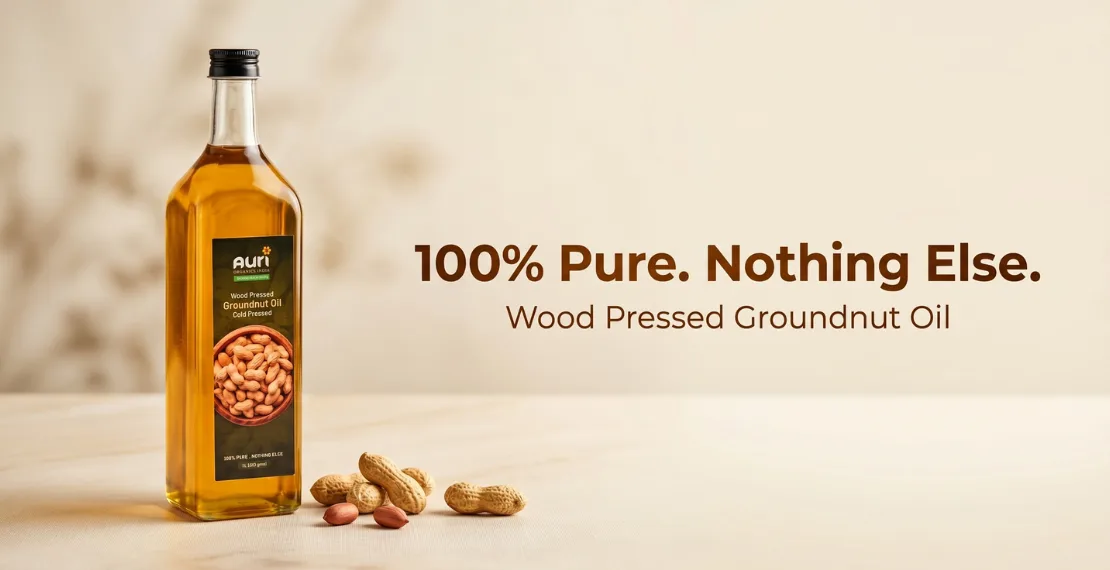
Wood pressed groundnut oil is extracted from peanuts using a traditional wooden press called a kolhu or ghani. The process is slow, no high heat, no chemicals. Just steady pressure that lets the oil flow out naturally. And because nothing harsh is done to it, everything that makes groundnut valuable stays intact, healthy fats, Vitamin E, antioxidants, and that rich flavour.
This is also where organic groundnut oil comes in. When the peanuts are grown without pesticides or synthetic fertilisers, the oil is clean from the source itself. That extra level of purity makes a real difference, even if it slightly affects the overall groundnut oil price.
At its core, this isn’t a new trend. Wood pressed groundnut oil is simply the original way oil was meant to be made, long before processing and shelf life became more important than nutrition. Moreover, when you opt for organic groundnut oil, you are getting the real thing but at a better source point, despite the slightly high cost of groundnut oil.
What Is Refined Groundnut Oil?
Refined groundnut oil is, quite literally, a whole new product, despite being labeled as groundnut oil.
The refining process of the groundnut oil is quite straightforward:
- The groundnuts are first crushed using high heat, and right there, a chunk of the nutrition is already gone because heat-sensitive nutrients don’t survive.
- Then chemical solvents, usually hexane, are used to pull out every last drop of oil from the crushed seeds.
- After that, the oil goes through bleaching to strip out the colour, and deodorising to remove the natural smell.
- Finally, preservatives go in so the oil can sit in a warehouse and then on a shelf for months without going bad.
What comes out the other end is a pale, clear, odorless liquid. It looks clean. It fries things. But nutritionally? It’s been through so much that there’s barely anything meaningful left to offer, especially when compared to natural options like organic groundnut oil.
Refined oils are cheap to make, that’s why they dominate the market. The lower groundnut oil price makes them appealing, but “cheap to make” and “good for you” are two very different things.
Wood Pressed Groundnut Oil vs Refined Oil
Here’s the comparison laid out simply, because sometimes a table says more than three paragraphs:
One thing worth addressing: the shorter shelf life of wood pressed groundnut oil sometimes puts people off. But think about it, that shorter shelf life is proof that nothing artificial was added to make it last longer than it naturally should. Real food spoils. That’s not a flaw. That’s just what real food does.
Benefits of Wood Pressed Groundnut Oil
Here’s where it gets good. And by good, we mean genuinely, practically good, not marketing-speak good.
The Fats in It Actually Work for You
Wood pressed groundnut oil has a healthy ratio of monounsaturated and polyunsaturated fats. These are the fats your body knows what to do with, they support brain function, help absorb fat-soluble vitamins, and keep you feeling properly satisfied after a meal. Not the kind of full where you feel heavy and regretful. The normal, comfortable kind.
Antioxidants That Actually Survived the Process
Because no high heat is involved in making wood pressed groundnut oil, the Vitamin E and natural antioxidants that exist in the groundnut actually make it into the bottle. Antioxidants matter because they help protect your cells from slow, cumulative damage. When you go a step further and choose organic groundnut oil, from peanuts grown without chemicals, you’re getting antioxidants from a source that was clean to begin with.
Good for Your Heart Over Time
The monounsaturated fat profile of wood pressed groundnut oil is genuinely associated with better cholesterol balance. This isn’t a bold claim on a bottle, it’s how these fats interact with your body. Used regularly as part of normal cooking, it’s one of the friendlier oils for long-term heart health, especially when using organic groundnut oil.
Easier on Your Gut
No chemical solvents were used. No bleaching agents. No preservatives. When you cook with wood pressed groundnut oil, your digestive system isn’t quietly dealing with trace amounts of whatever industrial chemicals went into the refined version. That matters more than most people realise, especially if you’re eating cooked food every single day.
Slow, Steady Energy
Healthy fats release energy gradually. Meals cooked in wood pressed groundnut oil tend to keep you going longer, no energy spike followed by that 2pm crash. It’s a subtle difference but one you’ll notice over time, even if the groundnut oil price is slightly higher.
Nothing Hidden in Your Food
This one’s simple. Wood pressed groundnut oil is just oil pressed from peanuts. That’s it. There’s nothing else in there. No solvents left from the extraction process, no added preservatives, just pure and clean products that you can use for cooking, groundnut oil at the right price for it.
Your Food Will Actually Taste Better
This is the one that wins people over immediately. The first time you make a simple tadka with wood pressed groundnut oil, mustard seeds, curry leaves, and a couple of dried chillies, the aroma is completely different. Richer. Warmer. More alive. Dal tastes more like dal. Fried snacks taste like something you’d actually crave.
Organic groundnut oil from well-sourced peanuts takes this even further, the flavour is more pronounced, more complex, genuinely more satisfying.
Common Uses of Wood Pressed Groundnut Oil
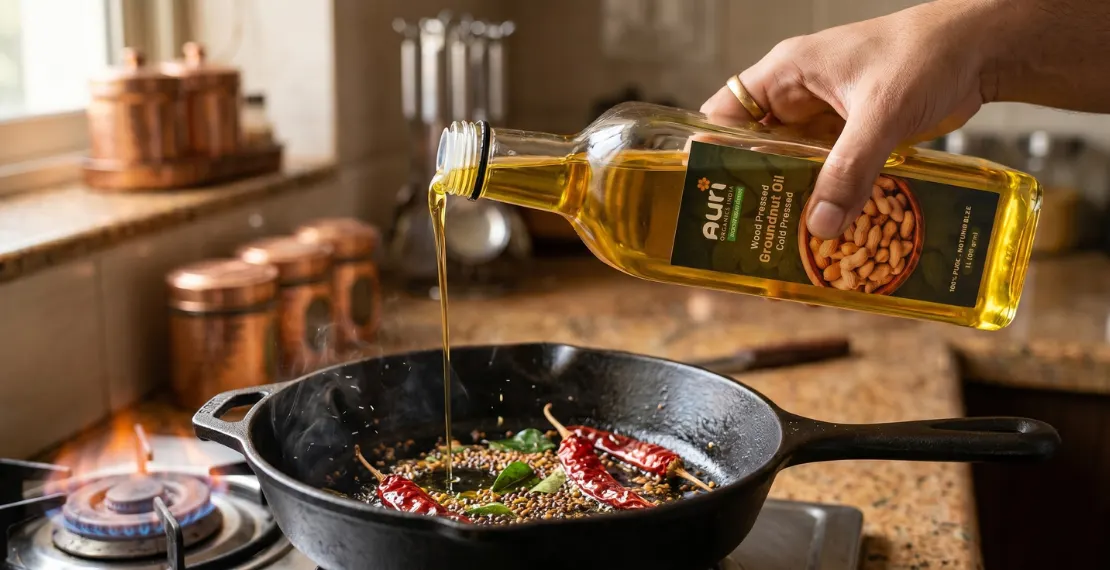
Wood pressed groundnut oil is extremely flexible and can be used effortlessly both in cooking and in skin care:
- Cooking: Great for deep-frying, sautéing, or using in Indian cuisine. It gives food a nutty yet subtle taste.
- Deep Frying: Due to the high temperature resistance, it does not burn but stays stable throughout the process.
- Skin Care: Can be used as a moisturizer to fight skin dryness and maintain its hydration.
- Hair Care: Massaging one’s head with it makes hair stronger, smoother, and less dry.
Since it undergoes minimal processing, it preserves its natural properties and becomes very handy for cooking and skincare purposes. Organic groundnut oil in particular will be the best choice, considering that it comes with a higher price tag.
Is Wood Pressed Groundnut Oil Better Than Refined Oil?
Yes, and truthfully, it isn’t even close to being a tough choice.
Refined oils are subject to extreme heat, solvents, bleaching, and deodorization. By the time you get your hands on it, it has been changed almost beyond recognition. The flavour is gone. What’s left is just a functional cooking medium, it’ll fry things and sauté things, but it’s not doing your body any particular favors, even if the lower groundnut oil price makes it seem like a better deal.
Wood pressed groundnut oil is the same oil it was when it left the peanut. Nothing stripped, nothing added, nothing altered. That simplicity is exactly the point, especially when you choose organic groundnut oil for cleaner sourcing and better quality.
The shelf life concern comes up a lot. Yes, wood pressed groundnut oil doesn’t last as long as refined oil. However, when you cook on a regular basis, one bottle should last for two months without any difficulty. Simply keep it away from heat and sunlight. There is no problem with its short shelf life. This is just how natural food products appear to look.
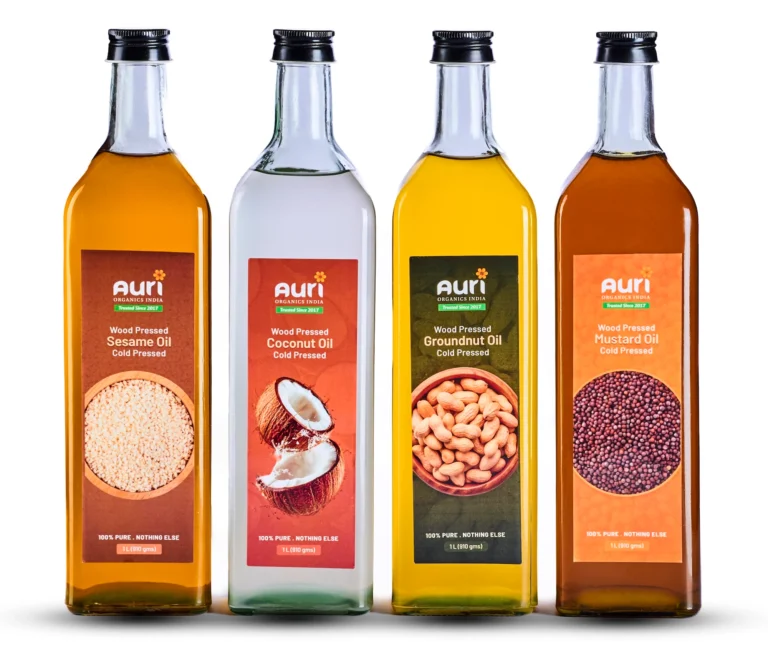
Wood pressed sesame oil and wood pressed mustard oil present the exact same choice between themselves and refined oils as well, leading to the exact same result. Natural extraction, no chemicals, nutrition intact. The traditional method wins.
Wood Pressed Groundnut Oil Price Guide
Groundnut oil prices may vary greatly. Knowing the factors that affect the price will assist you in making a more informed purchase. Quality is one of the main factors; oils extracted from high-quality sources are more expensive than oils from mass-produced sources. The source of the oils also makes a difference; oils obtained from plants grown in good conditions without chemicals are always more expensive.
The process of extraction is another significant factor. Wood press is a more time-consuming process with low efficiency. It means that a lesser amount of oil will be obtained during the wood press process, hence affecting the groundnut oil price. No chemicals are added in the process of producing oils like in refined oils, making the oils more pure but expensive.
Cheap oils are often refined, processed to extend storage, and are depleted of nutrients. The best oils, on the contrary, keep their natural flavors, properties and health benefits especially when you purchase organic groundnut oils derived from well-managed, clean peanuts.
Instead of focusing solely on the price, it’s crucial to think about the value. A slight increase in price for groundnut oil usually means more nutrition, purity and long-term advantages, making it a better option for your well-being.
How to Identify Pure Wood Pressed Groundnut Oil
The market is full of oils that call themselves “natural” or “cold pressed” without really being either. Here’s how to spot the genuine article:
- Smell it. Open the bottle. There should be a warm, nutty, distinctly peanut-y aroma, not overpowering, but clearly there. If it smells like nothing at all, it’s been refined.
- Look at the colour. Natural wood pressed groundnut oil is golden to amber. Not water-clear. An oil that’s completely transparent has usually been bleached to look that way.
- Feel the texture. It’s slightly thicker than refined oil. In colder temperatures it may partially solidify, that’s totally normal and actually a reassuring sign.
- Read the label properly. “Wood pressed,” “cold pressed,” or “kachi ghani” should be stated clearly, not buried in small print. If the label just says “natural groundnut oil” without explaining the process, be sceptical.
- Look for sediment. A small amount of natural settling at the bottom is completely fine. It means nothing was over-filtered to make the oil look artificially perfect, something you’ll rarely see in genuine organic groundnut oil.
How to Choose the Best Wood Pressed Groundnut Oil
Choosing the right oil doesn’t have to be complicated, you just need to pay attention to a few basics. Once you know what to look for, it becomes much easier to separate genuinely good oil from something that’s just well-marketed.
Check the extraction method:
The label should clearly mention wood pressed, cold pressed, or kachi ghani. If it’s not written, it’s better not to assume.
Look at where the groundnuts come from:
Good oil starts with good-quality seeds. Brands that are open about sourcing usually care more about quality, especially when producing organic groundnut oil.
Go for glass packaging:
It might seem like a small detail, but glass keeps the oil stable. Plastic, especially in heat, isn’t ideal over time.
Pay attention to how transparent the brand is:
If a brand clearly explains how their oil is made, it’s a good sign. If everything sounds vague, it usually is.
Don’t rely on big claims:
Words like “natural” or “pure” don’t mean much unless they’re backed by actual details.
One simple trick that helps is looking at what else the brand makes. If they follow the same traditional process across products, like wood pressed sesame oil, wood pressed mustard oil, or even things like Cold Pressed Coconut Oil and Wood Pressed Coconut Oil, along with clean products like almond butter, it usually means they’re consistent, not just chasing trends.
Brands like AURI ORGANICS INDIA make this easier by being upfront about their process and sourcing, which helps you choose with a lot more confidence, especially when you understand how groundnut oil price often reflects the quality and authenticity of the product.
Mistakes People Make When Buying Groundnut Oil
These are common. Don’t let them catch you out.
Going straight for the cheapest option. The lowest groundnut oil price on the shelf almost always means the most processing. Price is not the only metric that matters here, and a slightly higher groundnut oil price often reflects better quality.
Thinking all groundnut oils are basically the same. They really aren’t. The gap between a genuine wood pressed groundnut oil and a refined one is enormous, in process, in nutrition, in taste, and in what it does for you over time.
Not reading the label. This is the big one. “Natural” and “pure” are not regulated terms, anyone can put them on a bottle. What you’re looking for is the extraction method, stated clearly. If it’s not there, don’t assume it’s good.
Falling for the “natural” branding trap. A rustic label, an earthy colour palette, a few leaves in the logo, none of that means the oil inside is actually cold pressed. Read past the design.
Buying more than you’ll use. Unlike refined oil, wood pressed groundnut oil has a natural shelf life. Buy a quantity you’ll realistically go through in two to three months. Use it up. Buy fresh. That’s how it’s meant to work.
So, Is It Worth Making the Switch?
Here’s our honest take.
If you cook Indian food regularly, and most of us do, wood pressed groundnut oil belongs in your kitchen. It’s not about being a health obsessive or spending unnecessarily. It’s about using an oil that actually comes from real food, made in a real way, that adds something to your cooking instead of just sitting there doing the bare minimum.
The higher groundnut oil price is real, but it’s honest. The shorter shelf life is real, but it’s manageable. The benefits, better nutrition, better flavour, no chemical residue, long-term health support, are also very real.
Organic groundnut oil from a reliable brand that uses actual wood pressing is among the most straightforward yet significant changes you could apply in your daily cooking habits. Not because it has been recommended to you by someone who wants to prove how cool they are. Because it’s actually better, and deep down inside your head, you already know that.
A company such as Auri Organics was created precisely to facilitate this process, making sure you could always get the authentic product without getting a PhD in Chemistry just to read the labels. If you come across one that’s not only transparent but also consistent and authentic with its claims, then stick with it. The first step to good food is good oil.
Are you still cooking with refined oil… or just used to it?
Most oils look the same on the outside, but what’s inside makes all the difference. If your daily cooking oil has gone through heavy processing, it may have already lost what truly matters. Make a smarter switch to wood pressed groundnut oil — pure, natural, and closer to what your food actually deserves.
FAQs
What is wood pressed groundnut oil and how is it different from refined oil?
Groundnut oil extracted using the traditional method of wooden kolhu without heat and chemicals is wood pressed groundnut oil. Refined oil is extracted using high temperature and solvents thus losing most nutrients. The difference is huge compared to pure organic groundnut oil.
Is wood pressed groundnut oil good for daily cooking?
Certainly. Due to its high smoking point, it is excellent in cooking as well as deep frying. Moreover, it improves the taste of food making groundnut oil one of the best options to consume regularly.
Why is wood pressed groundnut oil more expensive than regular oil?
As the process is slow, produces lower amounts of oil and utilizes good-quality peanuts. Wood pressed groundnut oil price is associated with purity, labor-intensive method and quality. High groundnut oil price means it comes from a superior source.
How can I check if groundnut oil is pure?
It should have a nutty smell, golden yellow, and thick. Its packaging must mention wood pressing or cold pressing. Authentic organic groundnut oil will always give detailed information about its preparation.
Is organic groundnut oil better than groundnut oil?
Yes, since organic groundnut oil is obtained from chemical free peanuts which are healthier compared to normal ones. Although it costs a bit higher, it is worth it since its quality is incomparable.